
What Drives the Cost of a Custom Filter: A Cost Breakdown Buyers Can Negotiate
Two quotations for the same custom filter can differ by 40 per cent and both be honest. One factory is quoting a part it already makes, with a different label. The other is quoting a part it will tool, build in a small batch, and pack in a custom box. The difference is not in the margin. It is in what each quote assumes about how the part will be made.
For a buyer, the useful question is not “why is this supplier more expensive” but “which cost lines in this price move with volume, which do not, and which can be changed without changing the product”. This guide breaks a custom filter price into its components, shows which parts scale and which are fixed, and identifies where negotiation is productive and where it quietly degrades the product. It covers oil, fuel, air, hydraulic and coolant filters sourced from a Chinese manufacturer for distributors, fleets and private-label brands.
In this guide
- The structure of a custom filter price
- Media: the largest variable cost
- Housing and hardware
- Valves and seals
- Tooling: the fixed cost that is not per unit
- Assembly labour and batch size
- Packaging and branding
- Freight and landed cost
- What to negotiate, and what not to
- How MOQ is really calculated
- Frequently asked questions
The structure of a custom filter price
A filter price decomposes into material, conversion, tooling amortisation, packaging and margin. The proportions vary by filter type — an air filter is dominated by media area, a spin-on oil filter by the housing and valve assembly, a hydraulic cartridge by media and collapse construction — but the shape of the breakdown is consistent.
| Cost line | Behaviour with volume | Negotiable by |
|---|---|---|
| Media | Scales roughly linearly, with step discounts at mill order quantities | Specification and order size |
| Housing and metal parts | Scales linearly; unit cost falls with tooling amortisation | Tooling route and batch size |
| Valves, seals, gaskets | Low unit cost, purchased in; small discounts at volume | Standardisation on common parts |
| Tooling | Fixed, amortised over the order or paid up front | Payment structure, not price |
| Assembly labour | Per unit, with efficiency gains at larger batches | Batch size and changeover frequency |
| Inspection and testing | Partly fixed per batch, partly per unit | Sampling plan |
| Packaging | Per unit, but with high setup cost for custom print | Print route and quantity |
| Freight | Per shipment, and heavily cube-dependent | Loading plan and mode |
Media: the largest variable cost
Media is usually the biggest single material line and the one where specification decisions have the largest price effect. The gap between cellulose and full synthetic glass microfibre is not marginal: it can double the media cost of an element, and media is often a third or more of the total.
| Media type | Relative cost | Where it is justified |
|---|---|---|
| Standard cellulose | Baseline | Short service intervals, non-critical circuits, cost-driven aftermarket |
| Cellulose-synthetic blend | Moderate premium | General machinery and fleet use with normal intervals |
| Full synthetic glass microfibre | High premium | Extended intervals, cold start, high-efficiency requirements |
| Stainless steel mesh | High, but cleanable | Washable applications, high temperature, suction strainers |
| Specialty coated or laminated | Highest | Water separation, specific chemical compatibility |
The negotiating insight here is that media specification and service interval are linked, and the cheapest media is not the cheapest ownership cost. An element that costs less but needs replacing twice as often costs more over a season, and it costs labour and downtime as well. When a price is challenged, ask whether the reduction is coming from media grade — because that is a change to the product, not to the price.
Pleat design is the other lever on media cost. More pleats mean more media area, more dirt capacity and a higher price. Fewer pleats at the same micron rating mean the same filtration efficiency on day one and a shorter service life. If a supplier offers the same rating at a lower price, the question to ask is what happened to the pleat count and the media area.
Housing and hardware
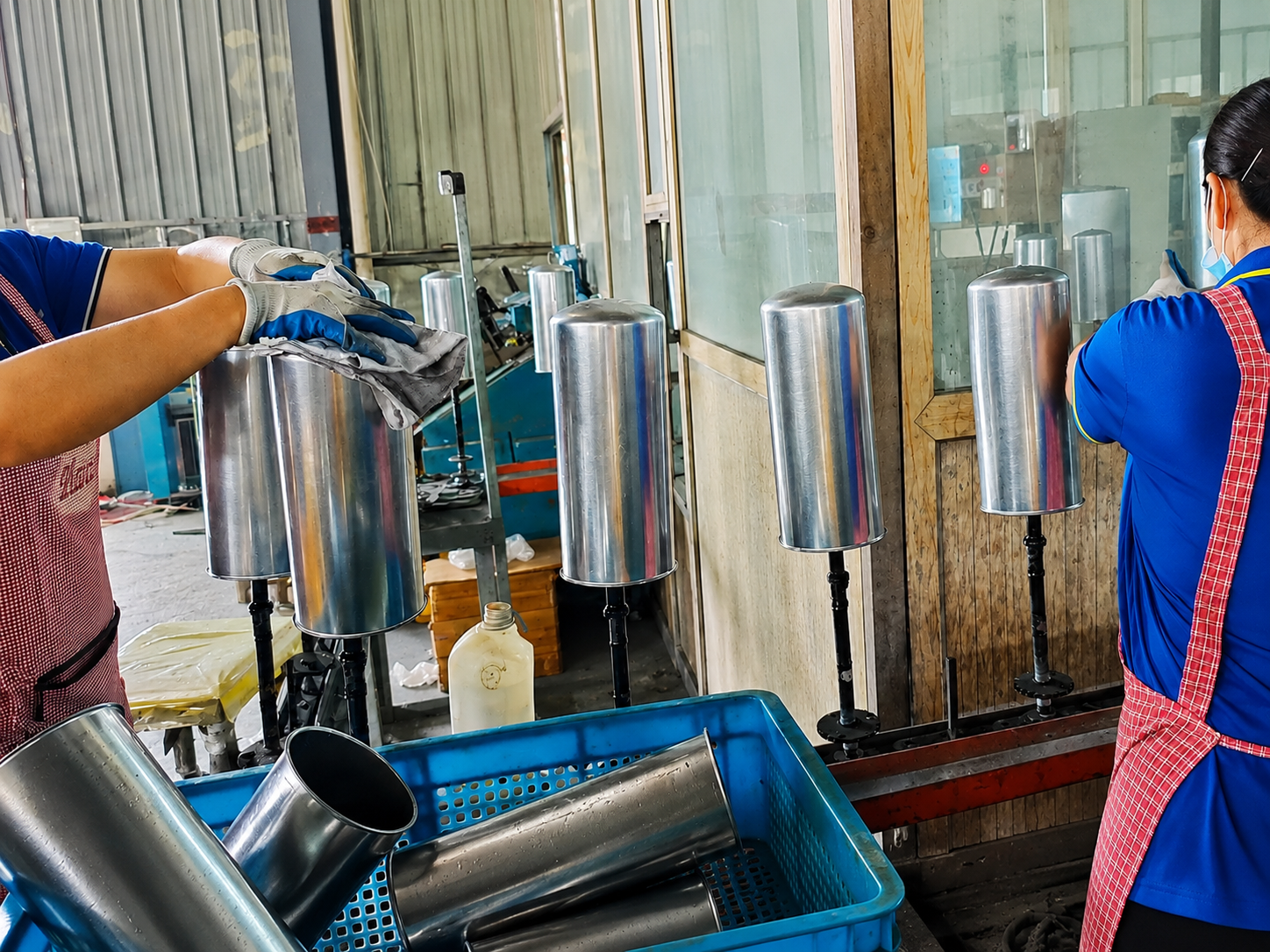
Housing cost is driven by material grade, wall thickness, coating and the tooling that produced it. It is also the line where scale economies are most visible: the same can, produced on the same tool in a larger batch, costs materially less per unit than in a small batch, because the setup is spread over more pieces.
| Factor | Effect on cost | Comment |
|---|---|---|
| Steel grade and thickness | Direct material cost | Set by burst and corrosion requirements, not preference |
| Coating | Per unit, plus setup | Painted, plated or coated; affects corrosion life |
| Thread machining | Per unit conversion | Rolled threads are cheaper than cut threads at volume |
| Dome and base geometry | Tooling complexity | Deep draws and non-standard profiles cost more to tool |
| Burr and finish requirements | Inspection and rework | Cosmetic standards on internal surfaces are expensive |
Where a buyer can genuinely save on housing is by accepting an existing body rather than specifying a new one. A new housing tool is a five-figure investment in most cases and it rarely buys anything the machine can detect. If the existing body fits the application, the cost of a new one is almost entirely a design preference being paid for twice — once in tooling and again in the higher per-unit cost of a small batch.
Valves and seals
Valves and seals are cheap per unit and disproportionately important. A bypass valve, an anti-drainback valve and a set of gaskets together are usually a small percentage of the price, which means that cutting them is a poor way to reduce cost and a good way to create field failures.
| Component | Relative cost | What the specification buys |
|---|---|---|
| Bypass valve | Low | Flow protection at the correct differential pressure |
| Anti-drainback valve | Low | Oil retained in the galleries at shutdown |
| Gasket or O-ring | Very low | Sealing across the temperature range |
| Seal compound upgrade | Small premium | NBR to HNBR or silicone for higher temperatures |
| Centre tube | Low to moderate | Element support and clean-side flow path |
Tooling: the fixed cost that is not per unit
Tooling is the line that most often confuses price comparison, because it can be presented in three different ways and the three are not equivalent.
| Tooling arrangement | How it appears in the quote | Effect on unit price | Effect on the buyer |
|---|---|---|---|
| Amortised into unit price | Higher unit price, no separate line | Higher while volume is low | No upfront cash; pays over the first orders |
| Paid up front by buyer | Separate tooling invoice, lower unit price | Lower from the first unit | Upfront investment; usually buyer-owned tool |
| Absorbed by factory at volume | Standard unit price, tooling written off | Reflects volume commitment only | Requires a credible volume commitment |
These are not three prices for the same thing. They are three ways of financing the same fixed cost, and a supplier that quotes a lower unit price because the tooling moved up front has not given a discount — it has changed the payment schedule. Compare total cost over the expected order quantity, not unit price alone.
Tooling amortisation is also where the volume question becomes concrete. If a tool costs a fixed amount and is amortised across the first order, halving that order doubles the per-unit burden. That arithmetic, rather than a policy on minimum order quantity, is usually what actually sets the floor on order size.
Assembly labour and batch size
Assembly labour is a per-unit cost with a batch-size elasticity. Every production run carries a setup: line changeover, fixture change, first-piece inspection, and a ramp back to full rate. Spread over a large batch, setup is negligible per unit; over a small batch, it is a significant line item.
This produces a pricing curve, not a price:
| Batch size band | Setup contribution per unit | Typical pricing behaviour |
|---|---|---|
| Sample or trial batch | Very high | Priced as a service, not as a product |
| Small batch | High | Noticeably above the volume price; often below cost floor of supplier |
| Line-efficient batch | Moderate | The realistic price for a first production order |
| Volume batch | Low | Best unit price; requires a stock commitment |
The practical implication is that there is a batch size at which the price becomes sensible, and asking for a smaller order at that price is asking the factory to absorb setup. A buyer who understands the curve can plan quantities instead of negotiating percentages — and often finds that a slightly larger first order at the same total cost delivers far better unit economics.
Packaging and branding
Packaging is where custom programmes routinely overspend, because the setup costs are invisible in a per-unit quote. Printing plates, die-cut formes and colour proofs are charged once, and they sit in the price whether the order is large or small.
| Packaging element | Cost behaviour | Cost lever |
|---|---|---|
| Standard stock box with label | Low setup, higher per-unit | Use for pilots and market tests |
| Custom printed box | High setup, lower per-unit at volume | Print plates amortised; needs volume to justify |
| Colour printing | Setup per colour | Reduce colours; use one-colour line art |
| Barcode and artwork | Administrative, one-time | Prepare early; reuse across the range |
| Shrink wrap or bag | Low per unit | Standardise across sizes |
| Inner protection | Per unit material | Match to handling, not to worst case |
Freight and landed cost
Freight is not part of the ex-works price and is often the largest surprise in the landed cost. Filter cartons are bulky relative to their value, which makes cube utilisation the dominant variable.
- Cube, not weight — most filter shipments are charged on volume rather than mass. Carton dimensions are a cost decision.
- Nesting and compression — cartons designed to nest, or elements packed without individual boxes, can reduce cube materially.
- Mode choice — express for samples and urgent spares, sea for production volume, and a deliberate decision at the boundary.
- Incoterms — FOB, CIF and DDP place both risk and cost in different places; the cheapest ex-works quote can be the most expensive landed.
A landed cost model is the only comparison that holds across suppliers, because it is the only one where freight, duty and packaging are in the same number. Ask every supplier for the same Incoterm and the same packaging specification, then compare.
What to negotiate, and what not to
Not every cost line is a legitimate negotiating target. Some are fixed financing decisions; some are specification; a few are the product itself.
| Line | Negotiable | Not negotiable without changing the product |
|---|---|---|
| Media grade | Volume pricing on a given grade | Downgrading grade to reach a price |
| Batch size | Planning quantity to hit a price band | Expecting volume price at pilot quantity |
| Tooling | Payment structure and amortisation period | Tooling cost itself, once quoted |
| Packaging | Print route, colour count, setup sharing | Custom print at stock-box pricing |
| Valves and seals | Standardising on common parts | Removing a bypass or drainback valve |
| Inspection | Sampling plan and frequency | Acceptance criteria and test scope |
| Freight | Mode, consolidation, carton cube | Documentation and compliance |
The pattern is simple: negotiate everything that changes how the work is financed, scheduled or packed, and treat the specification as fixed. The moment a discount comes from the specification, the product has changed, and the price comparison with other suppliers has stopped being meaningful.
How MOQ is really calculated
Minimum order quantity is usually presented as a policy. It is almost always arithmetic. A minimum order exists because a production run has to cover its setup and, where applicable, because media is purchased in mill quantities that do not divide down indefinitely.
Three components set it:
- Setup coverage — the run must absorb changeover, first-piece inspection and ramp-up.
- Media purchasing unit — the smallest quantity of the specified grade that can be bought without a premium.
- Tooling amortisation — where the tool is amortised, the order must carry enough units to keep the burden reasonable.
Frequently asked questions
Why is a custom filter so much more expensive than a catalogue part?
Because it is usually a smaller batch carrying the same fixed costs. A catalogue part spreads setup, tooling and inspection across a long production history; a custom part spreads them across one order. The material and conversion difference is often modest. Ask for the cost breakdown by line and the gap usually appears in setup and tooling, not in media or labour.
Can I reduce cost by using a cheaper media?
You can, and it changes the product. A lower-grade media at the same micron rating will filter similarly when new and hold less dirt before reaching its terminal pressure differential, which shortens the service interval. Whether that is acceptable depends on the application and on whether the buyer or the end user pays for replacement labour.
Is tooling always required for a custom filter?
No. Many custom programmes are configurations of an existing platform — a different element, valve setting, marking or packaging on a body already in production. Those require no tooling and are the fastest and cheapest route. Tooling is required when the dimensions or the interface differ from anything the factory already makes.
How do I compare quotes from different suppliers fairly?
Fix four things before comparing: the specification, the Incoterm, the packaging specification and the order quantity. Then compare landed cost per unit, not ex-works price. A quote that excludes tooling, or assumes stock packaging when you specified custom print, is not a comparable number.
Does a larger first order always produce a better price?
Up to the volume band of the line, yes. Beyond it, the gains flatten because the fixed costs have already been spread thin. The useful exercise is to ask for prices at three quantity bands — pilot, line-efficient and volume — and see where the curve flattens. Ordering just past the knee is usually the best balance of price and stock risk.
Who pays for test reports and certificates?
It varies and should be confirmed in the quotation. Standard inspection records and routine dimensional reports are normally included; third-party performance tests, material declarations and destination-market certificates may be charged. The cost is usually small compared with the cost of discovering, at the port, that a required document was never requested.
Want a cost breakdown instead of a single number?
Send the specification and the quantity band you are planning for. We will return the price broken down by media, housing, valves, tooling, packaging and freight, so you can see which lines move with volume.